Same shape, opposite briefs
What two 2015 FIAT 500s taught me about personality, hierarchy, restraint and knowing when to stop.
I own two 2015 FIAT 500s. They share a year, a basic shape and even the same Granito Lucente paint, but they could not have more different personalities.
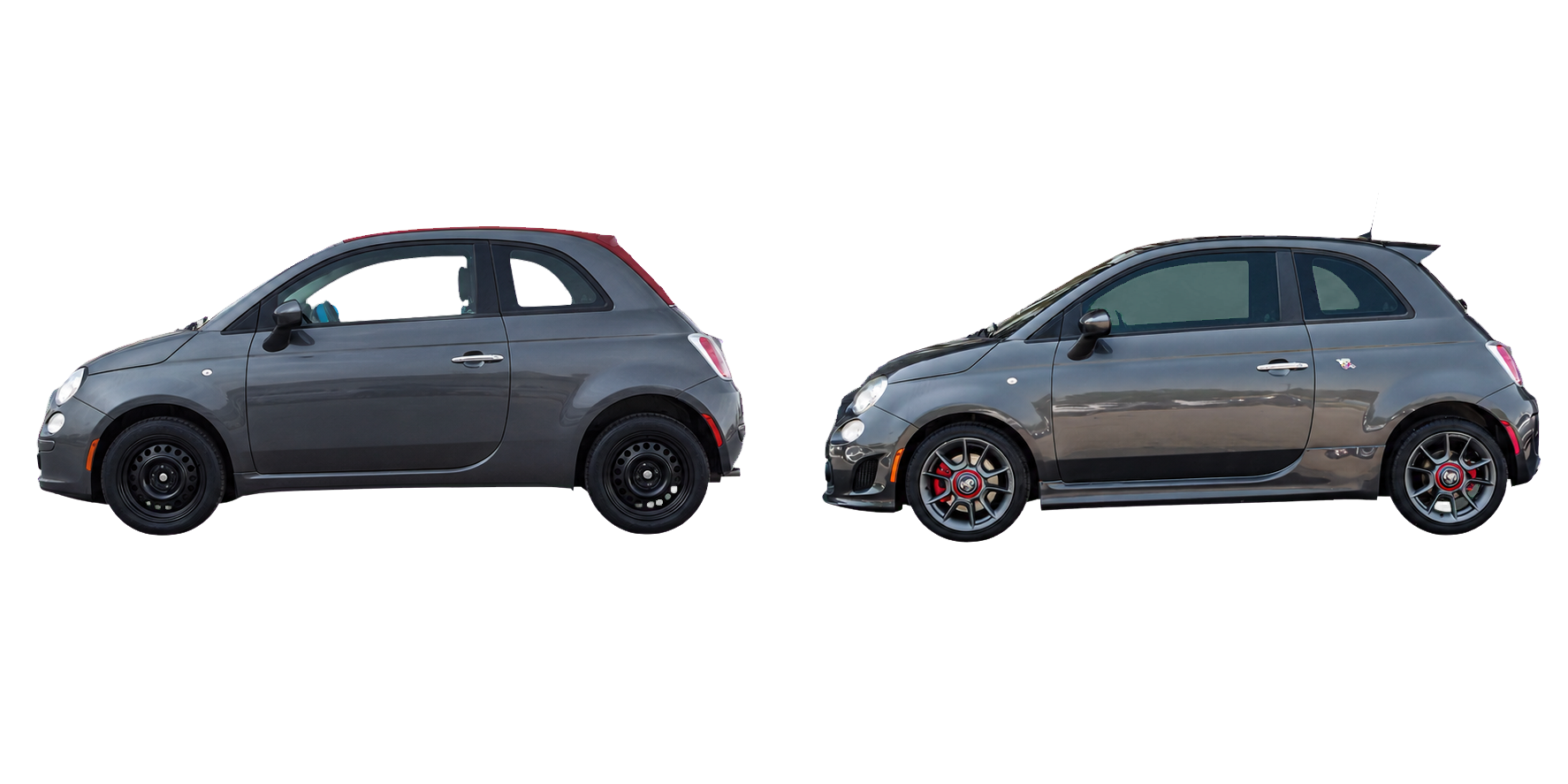 500c Pop
My manual 2015 FIAT 500c Pop taught me why these little cars are so lovable. It is simple, cheerful and full of character. The burgundy fabric roof gives the gray body a warmth it would not have on its own. With the top open, even an ordinary drive feels like an occasion.
It is not fast, but it does not need to be. It makes everyday driving feel lighter.
My 2015 FIAT 500 Abarth begins with the same familiar shape and turns the volume all the way up. The turbocharged engine, stronger manual transmission, larger brakes, firmer suspension and unmistakable exhaust give it an entirely different sense of purpose.
The 500c is a relaxed, sunny-day cruiser. The Abarth is a mischievous little troublemaker.
Two cars, two briefs
Working on the 500c is an exercise in making its character more visible. I am repairing components, sorting out the roof and refining details like the wheels and badges. Each change contributes to the way the car looks and feels. The work is meant to be seen.
The Abarth requires the opposite approach. It arrived from the factory with a clear hierarchy and a personality that already feels complete. Adding too much would only weaken it.
The goal is not to make the outside announce every modification. No stripes, fake vents or unnecessary visual noise. I want it to look composed on the outside while performing ridiculously well underneath.
| 500c Pop | 500 Abarth | |
|---|---|---|
| Personality | Cheerful and relaxed | Loud and mischievous |
| Project brief | Add visible character | Preserve visual restraint |
| Primary work | Roof, wheels, badges and repairs | Performance and mechanical refinement |
| Design rule | Make it personal | Do not overpower what already works |
| Desired result | A distinctive sunny-day cruiser | Quiet outside, ridiculous underneath |
One car is about making the work visible. The other is about making the work disappear.
Sound is part of the experience
The thing I love most about the Abarth is the sound. I love it—probably more than is reasonable.
The exhaust note does not feel like a soundtrack added to the car. It changes the way the entire car communicates. Starting it feels like an event. Moving through the gears feels more deliberate. Even at ordinary speeds, the sound makes the car feel alert and alive.
That sound is part of the interface between the car and the driver. It gives feedback, creates anticipation and makes the mechanical parts feel present. The 500c makes a drive feel special by opening the roof. The Abarth does it by making sure you can hear what it is doing.
Customization is interface design
Physical customization resembles interface design more than I expected.
Both depend on hierarchy. Some elements should attract attention while others quietly support them. The burgundy roof can be the defining visual feature of the 500c because the rest of the car gives it room. The Abarth already has its stance, wheels, brakes, badges and exhaust. It does not need another layer of decoration competing with them.
Both also require restraint. Adding another feature or visual element is usually easier than deciding the design is already complete. The best change is not always the most visible one.
Then there is iteration. Make one change, live with it and decide what the next change actually needs to solve. A wheel that looks right in a photograph may feel wrong on the car. A performance modification may sound exciting but make the car less enjoyable on an ordinary drive. The result reveals itself over time.
Details are not interchangeable
Owning both cars has also taught me to pay attention to small differences. A part listed for a “FIAT 500” does not automatically fit an Abarth. The VIN, engine, transmission, brakes and body style all matter. Even cars that share certain service parts can require different fluids and maintenance schedules.
Interfaces work the same way. Two components may look nearly identical while serving different purposes or operating under different constraints. Similarity does not mean interchangeability. Good design requires understanding those differences instead of flattening them.
I did not simply replace one FIAT with another. The 500c helped me discover what I love about the platform. The Abarth gives me more involvement, more sound, more performance and somehow even more personality.
They share the same paint and the same unmistakable shape, but neither one has ever felt ordinary.